Below is an annotated list of children's literature for the elementary classroom. The books are organized by the Six Elements of Social Justice Curriculum Design (Picower, 2007). It is based on work by pre-service teachers at Montclair State University. They have read and reviewed these books and provided insights into how they can be used in K-5 settings.

Sunday, November 8, 2015

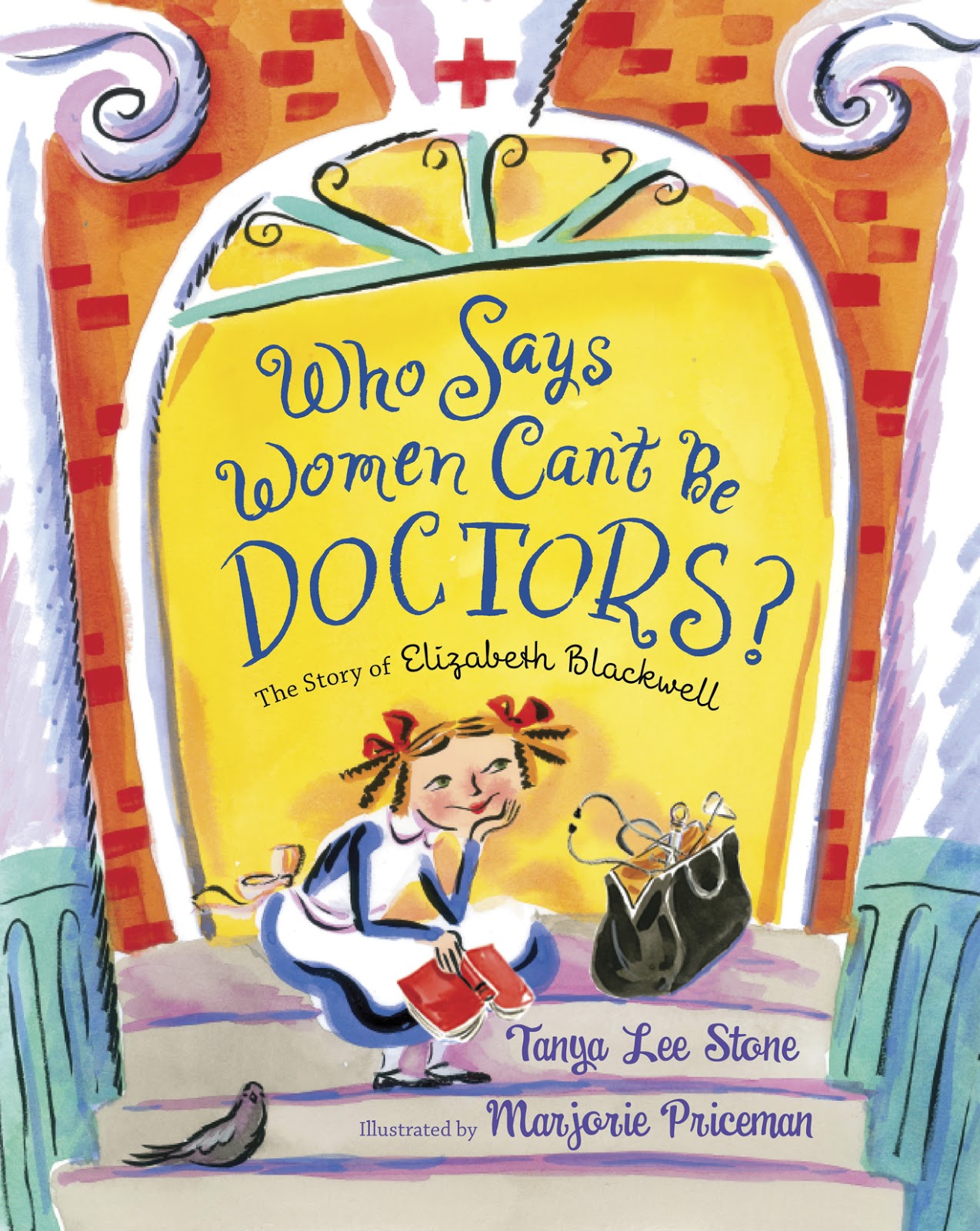
Who Says Women Can't Be Doctors: The Story of Elizabeth Blackwell

Title: Who Says Women Can't Be Doctors: The Story of Elizabeth Blackwell
Author: Tanya Lee Stone
Illustrator: Marjorie Priceman 
Grade Level: K-3

Summary: Who Says Women Can’t Be Doctors?: The Story of Elizabeth Blackwell by Tanya Lee Stone tells the story of Elizabeth Blackwell’s journey to become the first woman doctor.  The book starts off by introducing the reader to the idea that women were not always allowed to be doctors.  Then the reader learns about Elizabeth Blackwell and how she had not always wanted to be a doctor.  There was one person in Elizabeth’s life that empowered her to become the first female doctor.  After being criticized and turned away by many medical schools, Elizabeth persevered and would not give up.  She was finally accepted into Geneva Medical School.  Elizabeth was not accepted by her peers at first, but she proved them wrong and became the first woman doctor.  Elizabeth paved the way for more women to become doctors

Element 4: In Element 4: Social Movements and Social Change, students learn how regular people can address social injustices and make a change.  They learn that change can be made by people working together about something they feel passionate about.  I feel that this book is an excellent representation of Element 4.  If it had not been for Elizabeth Blackwell, women could have been denied the right to be doctors and apart of many other careers for many years.  The book discusses how in the 1800s women were only allowed to be wives, mothers, and maybe teachers.  But Elizabeth Blackwell was an ordinary girl who changed this injustice for all women.  By reading this book students will see that it is possible for anyone to make a change as long as they are committed and don’t give up no matter how many obstacles they face.      


How to Use: In the classroom I would use this book during Women’s History Month, which is celebrated in March.  I would do a read aloud of the book, stopping along the way to ask my students questions about why they think women could not be doctors and why people laughed at Elizabeth for wanting to become a doctor.  After reading I would have a class discussion on women’s rights and show my students how women did not always have the same rights as men, using the book as a main example.  For homework I would have my students journal on their feelings about what Elizabeth did and how they think life would be different if she had not become a doctor.  The next day I would have them share out their ideas on how life would be different and discuss how important it can be to stand up for a change when you feel something is not right.     

Giant Steps to Change the World by: Spike Lee & Tonya Lewis Lee

Title: Giant Steps to Change the World
Author: Spike Lee & Tonya Lewis Lee
Illustrator: Sean Qualls
Grade Level: 3rd-4th grade

If you are interested in adding this book to your library Buy It Here!

For more information about Giant Steps to Change the WorldSpike Lee & Tonya Lewis Lee, and Sean Qualls or possible lessons Click Here!

Summary:

Giant Steps to Change the World by Spike Lee & Tonya Lewis Lee is an inspiring children's book about taking action. Throughout the book, the authors discuss many issues that someone can go through while trying to make a difference. However, they emphasize the idea of pushing through and believing in ones-self. The challenges that are mentioned in the book are also compared to famous examples of people who went through similar things. Their names were not said specifically, however, the person is briefly described with what they accomplished. Each person described is named in the front and back covers of the book along with a quote they have said. This includes people such as Jesse Owens, Marva Collins, Ben Carson, Harriet Tubman, Mother Teresa, Langston Hughes, Albert Einstein, Tuskegee Airmen, Jean-Michel Basquiat, Barak Obama, and Neil Armstrong. The book ends posing a question to the reader, "what's your next step going to be?" This allows children to think about issues they see and how they can be changed. This would be a great book to start children in thinking about different actions they would like to take. 

Element 4: Social Movement and Social Change:

Giant Steps to Change the World discusses twelve perfect examples of people who beat the odds and changed the world. Each one of them is briefly described with their accomplishments and some hardships that they went through. This represents Element 4: Social Movement and Social Change because the students will see different examples of people who are represented in social justice movements throughout history. The students have learned about a variety of groups who were impacted by social justice movements in Element 3. They can now connect specific people with the groups. Giant Steps to Change the World will show the children that even through all the hardships and struggles, people pull through and can make a difference. The entire book is about inspiring children to want to take action on an issue they recognize is occurring. The main idea is that students will think as though anything can be accomplished if they feel strongly enough about a topic. Because the book ends asking, "what's your next step going to be," the students understand it is important to make a difference and they can do it too. 

Use in Classroom:

Giant Steps to Change the World is an inspiring book for children to want to take social action. Lessons can be done previous to or after reading the book about the people it connects to, so the students can understand more about what these people did. The quotes in the book can be used as a matching game to the descriptions given about them. The students will be able to connect the names with their actions and visualize the change being made and the story behind it. Then the students can choose a problem they notice around them. This could be a big social issue or a small problem they see around school, because the first step does not need to be big. From this, the students can plan ways to make a change with these issues and begin to take action. This could be things like writing letters to a company or organization, talking to the principal, or making something to put around the school or the town. They can continue to follow up with their projects and see what type of difference they made. Each student can record the steps they took and results. These recordings can be made into a class book of impacts allowing others to read their book and be inspired as well. 

Monday, October 5, 2015

The Other Side by Jacqueline Woodson


The Other Side 
Author: Jacqueline Woodson 
Illustrator: E.B. Lewis 
Grade Level: K-3


Summary: This books tells a story about two young girls, Clover and Annie who live next door to each other. Clover sees Annie everyday playing outside, she is curious to who she is and wants to meet her. Unfortunately there is a fence dividing Clover and Annie. It would be simple for Clover to climb right over the fence, but that is forbidden according to Clover's mother. The fence is not only separating Clover and Annie from becoming friends but it is also separating two sides of the town they live in, the black side and the white side. Clover and Annie are dealing with racial separation in their town but just because a fence is in between these two young girls, it does not stop them from fighting against this separation. Clover and Annie find away to be brave and free so they can become friends because a wooden fence is not going to stop they from what they believe and from what they want to do.  

Element 3: Exploring Issues of Social Injustice 
          In this element we are to explore deeper the issues of social injustice ranging from racism, sexism, religion and so forth. Elements 1 and 2 have set our students up with learning how to accept ourselves and cultures as well as respect for others. Now in this element we can look deeper at how these issues and forms of oppression have affected different groups and cultures. More importantly how they affected the children of these groups and what they go through in dealing with these forms of oppression. This is a chance that as teacher we can link back to history and the experiences that impacted these people. The social injustice issue of racism is one that can be covered every year in every grade. Segregation of white and black was only a part of the oppression that African Americans had to go through. They were not only physically separated from the whites but over all not allowed to do or be with them in anyway, strictly "because that's the way its always been" according to Clover's mom from The Other Side. The book states that the reason this is the way it is is because blacks have always been inferior the whites. Even though the book starts out by explaining the separations they are going through, in turns everything around by showing two girls who recognize that they have different color skin but still want to be friends. They don't believe and see what adults and the rest of the world sees, which is separation. This is a story of two young girls fighting against separation for social justice and how powerful young minds can actual be. 

Activity: First I would introduce this book to the class and before reading it, I would ask them to make predictions. "What do you think this story is about?" or "What do you think is going to happen in this story?". Then I would read the story to the class and ask them questions during the reading such as "Why are they separated? Do you think that it is okay that they are separated?" and "Would you go over and ask Annie if she wants to play?". As an activity, I would then have the children go back to their desks and independently write a letter. They would be able to chose to write a letter either to the mayor of that town or either one of Clover or Annie's parents, explaining why the fence should be take down, why they shouldn't be separated and why they should be able to play together.
After they write their letters, I would have them exchange them with another student so that everyone can receive a letter to open and have them read what their fellow peers have said. This will be able to engage in conversations on this topic and students would be able to see what ideas, values and beliefs they have in common with each other. 


Hidden:A Child's Story of the Holocaust by Loïc Dauvillier


Hidden: A Child's Story of the Holocaust
Written by  Loïc Dauvillier

Illustrated by  Marc Lizano
Color by Greg Salsedo
Translated by Alexis Siegel

Grade Level:4-6
 Element: 3) Issues of Social Injustice
Summary
 Hidden by Loic Dauvillier  is  graphic novel for juveniles .  The book starts off with a little girl names Elsa who was asleep and hears her grandmother Dounia in the living room. Elsa thinks that her grandma has had a nightmare which was why she couldn't sleep so Elsa tells her grandmother to tell her all about her nightmare and it will make it all better. At first , Dounia is hesitant to tell her granddaughter but she reluctantly tells her the story in which she has never told anyone about - not even her own  son. Dounia's story goes into her childhood how she was a young Jewish girl in France during WWII who was  forced to wear the Jewish star, separated from her friends and family , had to go into hiding  , evade the Nazi police, escape the country & change her name.The  book ends with Elsa falling asleep and the next day Elsa, her grandmother and father are talking . Elsa had told her father that her grandma told her the story of her childhood in which her father was shocked the grandmother told her the story. The grandmother tries apologizing for telling it to Elsa but instead the father tells her its fine and that he wishes he had heard the story growing up .
Element Three: Social Injustice Issues
 This book is representative of element three: Issues of Social Injustice, because it introduces the topic of the Holocaust.It gradually introduces children into the religious intolerance without being too graphic  about the gas chambers, torture and mass genocide. The story goes into how  she was ostracized from others in her school and made to wear the Star of David .
Activity :
To incorporate this book into the classroom  it could cover multiple topics such as war, religious intolerance, survival, power of symbols but mainly the holocaust.   The way the book is written allows for teachers to pause at different sections to open up discussions  such as  why the students had to wear the gold stars or why they lied to the police. Teachers could also do a activity about differences in people and show how it feels to exclude someone because they are different and have a discussion on how each student felt.

Child of the Civil Rights Movement by Paula Young Shelton & Raul Colon


Child of the Civil Rights Movement
Author: Paula Young Shelton
Illustrator: Raul Colon
Grade Level: P-3

Summary:
The story is about the childhood of Paula Young Shelton, the daughter of civil rights activitist, Andrew Young. The book first gave late to the segregated and marginalized lifestyle of African Americans, where Jim Crow Laws ran rampant in southern states. Paula was born in New York, where these laws were not enforced. After the Freedom Riders protest, where white and black students rode on a bus to the south was set on fire in attempt protest the segregation laws in the south, Paula’s family went back to Georgia to face this inequity. The story is mainly about the protagonist’s first protest, where her father, Andrew Young was working alongside with Ralph Abernathy, Randolph Blackwell, Dorothy Cotton, James Orange, Hosea Williams, and Martin Luther King Jr. An incident occurred in a supposedly white and black inclusive restraint, where her and her family was denied seating. Her parents fought for their rights and were still denied, which lead to her family joining the American civil rights movement group to a 50 mile, 4 day march in Montgomery, Alabama. The results from this was when President Lyndon B. Johnson signed the 1965 Voting Acts Right, where Martin Luther King Jr. were on television signifying a rift in civil rights. The story ends with Paula explaining how after her parents were to grow old, it would be her duty as a child, alongside with others, to continue the march for the civil rights movement. 

Element 3 Exploring Issues of Social Injustice:
Element Three was outlined in this book when discussing the racist past of the United States of America. The story gives a firsthand perspective of an African American child who faced oppression during her childhood. The book mentioned many examples of Jim Crow laws, which segregated blacks and African Americans from most public settings and constructs. The rewarding aspect of this book covered the activism against the inequity and injustices towards black people. With the detailed and captivating illustrations, as well as the descriptions in the book, introducing all the members of the civil rights movement group, the book gives much leeway for teachers to make a unit researching other activists. It gives light to other famous figures that were major contributors to the civil rights movement. What made this book unique and relevant to the theme of social injustice was how it was told by the author who was a child during the 1960s. 

Activity:
As a follow-up activity, I would break the class up into groups and assign each group with a specific figure named in the book. This could include using computers, or using books from the school library. Each group is required to make a poster and present information to the class to give light to these brave social activists, during a time of horrible and unjust society in the United States. The poster can include illustrations, quotes, printed pictures, and facts about their assigned agent of social change. This could work in inclusive classrooms, as it would be appropriate to give students with IEPs and disabilities Martin Luther King Jr., the most popular figure named in this book, and would give them an opportunity to reinforce their knowledge on him. Other classes can explore figures they may not be familiar with, showing the class about other people who were involved to contribute in our current strides to become a more equal society.  

Ruby Bridges Goes To School: My True Story


Title: Ruby Bridges Goes To School: My True Story
Author: Ruby Bridges
Photograph Compilation Copyright: Ruby Bridges
Reading Level: Guided Reading Level - Kindergarten, Developing Reader - Grades 1-2
Publisher: Scholastic Inc

Find out more information on the book and purchase here!

Summary: This is the true story of Ruby Bridges who was the first African American child to go to a white elementary school. The parents of the white children didn't want a black child in the school so they pulled their children from the school and Ruby was alone with the teacher for many months. The children eventually came back and Ruby was able to be friends and enjoy school with them. Now white and black children can go to school together. Ruby grew up and got married; she is now a very well-known historical figure.

Element #3 Exploring Issues of Social Injustice:

This element is about diving into the historical aspects of racism, sexism, classic, homophobia, religious intolerance, etc and how they changed the way the world works today. It talks about how historical events changed different communities for better or worse. This book is very good for this element because it talks about the racial injustice issues in 1960 regarding segregation in schools. The photos in the book are also a fantastic view back in time to see how things really were back then. It is filled with real pictures of people with picket signs, pictures of Ruby, her teacher, her class-mates and more. It explains what the issue of the segregation was, what happened and then how the problem was solved. I believe this book is a great gateway to the historical issues of segregation for younger kids to understand this element in an easy, simple way. Ruby is now a civil rights activist, but you can learn even more about her here!

Activity:
Ideally, this book should be used during Black History Month around the time they learn about Martin Luther King Jr. and segregation. It would be used as a Read Aloud lesson, where we would pause and talk about things they might not understand. We would really be stressing to pay attention to the pictures, because the follow up activity after reading the book would be for them to make their own picket signs to support desegregation, as if they lived back in this time when Ruby was not wanted in the school with the white children.

Busing Brewster


Title: Busing Brewster
Written by Richard Michelson
Illustrated by R.G. Roth
Element 3: Exploring Issues of Social Injustice
Reading Level: Grades 1-4

Summary
            Brewster is excited to start the first grade at Franklin in Miss. Evelyn’s class, but his mother has unexpected news. Brewster and his brother Bryan will be going to Central now, which is the “white school.” As the boys take the bus to Central the following morning, they notice that there are people protesting on both sides of the street and a rock gets thrown through the window, shattering it. While Brewster gets a drink of water later on, a white boy pushes him from behind, saying that he didn't belong at Central. Bryan sticks up for his brother, calling the white boy “Freckle-face”, which lands the three boys in detention in the library all day. During detention, Brewster meets Miss O’Grady, and she shows Brewster the abundant of books at the library and teaches him that he could be anything that he wants to be, even President. Meanwhile, Bryan and Freckle-face are joking and laughing together. As the day comes to an end, Brewster tries to say bye to Freckle-face but with his dad standing right there, the boy wont say bye back when his father says that wishes colored people would only go to school at Franklin. Once Brewster comes home, he doesn't tell Mama what happened, but reassures her that he had a great day.

Element 3: Exploring Issues of Social Injustice
            During the 1970’s, there was an abundant of racism with schools becoming desegregated, allowing whites and blacks to attend the same school. Many African Americans were forced to attend schools that have been previously all white, and whites had to get used to colored students being in their class. Through this text, you can imagine what a common confrontation would be for a white and black student. Element three delves into the issues of racism, classism, etc., which is portrayed in the confrontation between Brewster and Freckle-face. By the end of the day, Freckle-face got along with Brewster and Bryan, but through his father’s negative comment, he felt like he couldn't be friendly with the boys. This is a perfect example of social injustice due to the racism and he hatred white people felt for African Americans going to their schools.

Activity
            I would first start by reading this book aloud to the class. While reading the book aloud, I would get my students involved, asking them how they felt at certain parts of the book and asking for predictions. Once I am done reading the book, I would assign a project, in which each student will draw a picture of themselves and then write a few sentences about what they want to be when they grow up. I would encourage my students that they could be anything they want in the world, just like Miss. O’Grady told Brewster. Once all the students complete the activity, I will create a book for our class, give each student a copy, and also have a copy in the classroom library, so all students could read it and learn a little bit more about their classmates.