Below is an annotated list of children's literature for the elementary classroom. The books are organized by the Six Elements of Social Justice Curriculum Design (Picower, 2007). It is based on work by pre-service teachers at Montclair State University. They have read and reviewed these books and provided insights into how they can be used in K-5 settings.

Saturday, November 9, 2013

Rosa


Author: Nikki Giovanni
Illustrator:  Bryan Collier
Grade Level: 3-5
Buy It Here
Resources

Summary:  
This book tells the story of Rosa Parks brave actions on an Alabama City bus on December 1, 1995. Rosa sat in the neutral section of the bus and began along her way home from work. The driver then ordered her and other blacks around her to get up to give their seats to on coming white passengers. As the others moved, she refused. Even after warning of calling the police Rosa stood her ground. Friends Of Mrs. Parks followed in her path of courage by trespassing into Alabama State college to make posters supporting their friend and her movement. They hung signs that said, Stay off the Buses, and No riders Today. Rosa's nonviolent protest encouraged people to stand behind her refusing to take the bus for about a year until a change was finally made.

Element 4: Social Movement and Social Change 
This book is perfect for element four. It shows how standing up for yourself can make a difference. It proves that with support from others coming together you can work hard to make an important change. Rosa Parks took a stand for what she believed in by not giving up her seat on the bus and by doing this she inspired others to stand up for their rights as well. 

Activities:
-JOURNAL ACTIVITY:
Write about something you would like stand up for in the school, community or your home in order to make a difference. 

-Have students act out the incident on the bus. Have people with light clothing be white and dark clothing be black. After the simulation discuss as a class how each side felt. 

-Write a newspaper article pretending you were a news reporter on the bus who witnessed the whole. Make a detailed report with dialogue. 

-Draw a poster that you would use to use in a segregation protest.


Friday, November 8, 2013

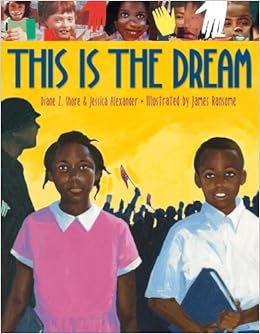
This Is The Dream - SJE 4: Social Movements and Social Change

THIS IS THE DREAM
Written By: Diane Z. Shore & Jessica Alexander
Illustrated by: James Ransome
Grade Level: 3-5
Purchase It Here!"This Is The Dream" celebrates social change and social movement through vivid imagery, as well as the use of poetry. The illustrations on the front cover invite children of all diversities to open the book and learn something new. Because the book is written in poetic verse, there is a sort of flow to each page. I also think the poetry in the book allows for using the book in more than just a social science context. It can be brought to life during a Language Arts lesson where students are learning the different forms of poetry. The poetic stanzas can be broken apart and analyzed by their historic content. I find that this book fits well when blending subjects. Needless to say, it can fit perfectly into a scripted curriculum, as well.
"This Is The Dream" illustrates scenes of segregation in various forms - in restaurants, at the water fountain, in schools, on the bus, etc. This is what the first half of the book is dedicated to. The second half is dedicated to showing the changes that have occurred because of social movement and change. My favorite thing about this book would be that it has many children throughout; it emphasizes that children too were affected by segregation, and they can also be a part of the integration and social change. In this quick read, social change is addressed, but that is not to say the book can stand alone as a teaching point.
The book will work well in conjunction with a p
articular social movement. It can emphasize points that may be unclear to students, as well as just providing something great for students to become involved with. In terms of specific lessons, this book can be used as an opener to a social science lesson. This can give students a friendly, interesting preview of what they will be learning. They are presented with the segregation and the conclusion of what came from social change and movements. Enjoy it!


Two Resources that can work with "This Is The Dream" 
& other Social Change & Movement Unit Plans: 
Martin's Big Words: The Life of Dr. Martin Luther King, Jr
Henry's Freedom Box: A True Story from the Underground Railroad
  

Sit-In: How Four Friends Stood Up by Sitting Down


Author: Andrea Davis Pinkney
Illustrator: Brian Pinkney
Grade Level: 3-5


Summary:
Sit-In: How Four Friends Stood Up by Sitting Down is appropriate for grades 3-5.  It is a story that depicts the historical event that occurred in Greensboro, North Carolina in defiance of segregation on February 1, 1960.  Four college students peacefully sat down at a “Whites Only” Woolworth’s counter and ordered food.  With the words of Martin Luther King Jr. in their minds, they enacted the first ever sit-in in hopes of ending the injustice of segregation between blacks and whites in restaurants and in public places everywhere.  This act was bravely repeated by others and grew in number and intensity throughout America.

Element 4:
Sit-In: How Four Friends Stood Up by Sitting Down represents element 4, Social Movements and Social Change, by teaching the reader about monumental movements of everyday people coming together to stand up for a cause in hopes of creating change.  This book focuses on the social injustice that black people endured during the 1960s in the US.  It demonstrates that with courage and in the spirit of love and peace, ordinary people can protest injustice in hopes of creating equality.  A single act started by four college students in Greensboro, North Carolina soon spread throughout other Southern US towns and the rest of the country.  This act eventually caught the attention of lawmakers and led to Congress passing the Civil Rights Act of 1964, which ended segregation in public places.  Sit-In: How Four Friends Stood Up by Sitting Down shows readers that through passion, determination, and nonviolent protest, one can create change.

Activity:
An activity that can be utilized with Sit-In: How Four Friends Stood up by Sitting Down is a read-aloud followed by a Protest Poster.  After reading the book aloud, I would engage in a class discussion on students’ thoughts and feelings on the book, utilizing high-order questioning strategies.  I would ask comprehension questions at all levels and address the illustrations to aid in understanding.  I would show a video clip depicting the four actual college students years later discussing the actions they took on the day of this first historical sit-in.  As a culminating activity, I would instruct students to think about an issue that they presently find unfair (example: bullying, etc).  Students would share their thoughts with a partner to discuss reasons for this unfairness.  Students would create individual protest posters to depict this injustice.  They can get as creative as they would like in this poster.  Upon completion, the finished posters would be proudly displayed on a class bulletin board.

Thursday, November 7, 2013

Heart on Fire: Susan B. Anthony Votes for President


Author: Ann Malaspina
Illustrator: Steve James

Purchase the book here!

Summary:
Heart on Fire depicts the uphill struggle that Susan B. Anthony faced in order to gain the right to vote.  When the time to register came, Susan B. Anthony quickly made her way to town hall because under the Constitution, “All persons born in the United States have the same rights, as citizen" and she felt this also applied to women and the right to vote.  Her registration was eventually granted, and on voting day Susan B. Anthony cast her vote along with several women.  However, several days later all of the women were arrested for voting illegally. Before her trial she toured the country trying to gain support for women’s rights and gained a great deal of encouragement.  Unfortunately, on the day of her trial she was found guilty; however, she believed so strongly in her rights that she refused to pay her court fine or go to jail.  Instead, she continued to advocate for women for years to come until June 4, 1919, when the Nineteenth Amendment would eventually be passed, giving women the right to vote. 

Element IV: Social Movements and Social Change
This book is a wonderful depiction of Element IV because it clearly discusses the social injustice against women, but focuses on the pride women, such as Susan B. Anthony, had and the efforts they made to end this social injustice.  This is a story of encouragement and helps to showcase the ability that one person has to make a difference.  While it took many people to eventually pass the Nineteenth Amendment, it started with the persistent voice of several women who believed very strongly in something and wanted to make a difference.  Just like our students, Susan B. Anthony was just an ordinary woman, and yet, she helped to change the world in a more positive way.   This book teaches all students, not just females, that they should stand up for the things that they believe in and they too have the power to make a change. 

Classroom Activity:
Class Vote: The teacher will facilitate a classroom vote for a topic of her choosing and allow both the boys and the girls in the classroom the opportunity to cast their vote.  The teacher will then review the results and determine what the outcome is when both parties get to vote.  Following that, the teacher should take away all of the girl’s votes and see if that changes the results.  For the sake of the lesson, the teacher could then reverse the roles/situation and take away the boy’s votes (leaving the girl’s votes) and see if that alters the results.  Depending on whether or not the outcome changes, the discussion may vary, but the teacher can facilitate a follow up discussion asking the girls and boys how they felt knowing their vote would not count.   This can be tied into the importance of having a democratic classroom today and why each of the students are allowed to have a voice and share their thoughts and opinions with the class.  

Wednesday, November 6, 2013

Uncle Jed's Barbershop


Title :  Uncle Jed's Barbershop
Author :  Margaree King Mitchell
Illustrator : James Ransome
Grade Level :  4th grade
Resource
Buy it here!


Summary
Uncle Jed’s Barbershop is a story told by a little girl named Sara Jean. The story starts off discussing Sara’s favorite uncle named Uncle Jed. Uncle Jed was the only black barber in the county. Uncle Jed always spoke about his dream to open his own barbershop. He has said it for years and no one ever believed that he would. Those days no one had dreams like that. Most people were poor. When Sara was five years old she got very sick and needed to travel 20 miles to go to the hospital on a wagon. The hospital had a specific “colored waiting room”. Although Sara was unconscious, the doctor would not see her until all white patients were seen first. Finally the doctor saw her and the doctor told her family she needed a surgery which was going to cost three hundred dollars. At that time, three hundred dollars was a lot of money and her father did not have it. She could not be operated on until the money was received, so Sara’s father went to speak to her uncle Jed. Uncle Jed claimed that money meant nothing when Sara was in the picture and he was going to do whatever it took to make sure nothing happened to Sara and she had the surgery. Uncle Jed came across a time of the great depression where he lost all his in his bank account. Jed continued saving all over again. At the end of the story, Uncle Jed finally got his barber shop; he opened it on his 79th birthday. It was everything he ever dreamed of. Uncle Jed died shortly after that, but he died a happy man. He made his dream come true even when no one else believed in it. He taught Sara to never give up on her dream, which she will always remember.

Element 4: Social Movement and Social Change
In my opinion Uncle Jed’s Barber shop is a great book that displays social movement and social change because it  helps provide students with a learning experience about standing up for what you believe in and following your dreams. Within the story, the family deals with hardships of low economic status, as well as segregation and discrimination. Being the only black barber in town, Uncle Jed did not give up. Despite the segregation of race and color, Uncle Jed had a dream and he followed it. In the end of the novel he accomplishes his dream, and teaches his niece that social change is possible, and you should not give up on your dream. This story is great because it shows how Uncle Jed overcomes segregation and tries to make a social change and still accomplishes his dream despite the hardships he faced. This story is great because it gives students hope in social movements and changes .

Activity
Prior background knowledge is given about segregation before the story is read. After the story has been read to the class; the horrible effects of segregation will be discussed as well as the hardships in Sara Jean's family experienced. 

Students will be asked  to give examples of what type of segregation could take place around the world. Next students will be asked to give the types of segregation that can happen  in schools. Students will be asked to list  their answers on the board, then  a class discussion will take place. Students will be asked to list ways to prevent segregation and its horrible effects.

Students will put their list together and create an "Anti- segregation" poster which will list rules in the classroom to prevent segregation. This will display the social changes we can make within a classroom to avoid segregation!

Sunday, November 3, 2013

Miss Moore Thought Otherwise


Title: Miss Moore Thought Otherwise
Author: Jan Pinborough
Illustrator: Debby Atwell
Grade level: 1st-4th
Publisher: HMH Books for Young Readers (March 5, 2013)
If you want to learn more about this book, the author, and Anne Carroll Moore click here!
If you like this book you might also like this

Summary:  Imagine a world where children were not welcomed in the library. Imagine a childhood where you had no place to go on the weekends to disappear in a book. No way to sink into your favorite chair and see your favorite librarian who felt like your aunt/uncle. Well we are lucky to have grown up with a special section just for children in the library thanks to Anne Carroll Moore.  This children’s book takes the reader on the journey of how Miss Moore established the first children’s room at the New York Public Library in 1911. The story talks to the reader about what Miss Moore’s childhood was like and exemplifies how much she loved books. However, it also supports women’s history and how women can step out of their traditional roles and start a movement.  Additionally, the vibrant illustrations represent the text and beautifully show the path of Anne Carroll’s history.

Element 4-Social Movement and Social Change: Miss Moore Thought Otherwise is a story about showing boys and girls that women have a role in history. It shows how one woman could take an idea and make it a reality. The story exemplifies how an everyday woman who lived in Maine broke out from the chains that bound her from her intellectual and individual freedom. It showed the reader how a very young woman can string together many people in order to get what she felt was right; a children’s room in the library. Her call to action was getting the children’s room in libraries and having it spread around the world.

Activity: For this book I would have the students go into the public library, map it out, and then have them create their own library. It could include anything they wanted but they would have to explain one unique feature they put in their model and why it should be in every library around the world.  They will then describe how they would petition for their unique section like Miss Moore did. The students will also make a brochure and tell the class why their library is special and how it reflects them.

I Could Do That! Esther Morris Gets Women the Vote

Add caption
Author: Linda Arms White
Illustrated by: Nancy Carpenter  

Grade Level: Kindergarten - 4  

Buy it here!  
Resources  
Summary: I Could Do That! Esther Morris Gets Women the Vote by Linda Arms White is a children’s book that is strategically written to explain that will and determination are characteristics that can help people achieve their goals.  The book begins with young Esther watching her mother make tea. Esther exclaims, “I can do that!” and proceeds to learn how to make tea. As Esther grows older she continues to observe her mother’s actions.  Each action her mother made, Esther believed she could learn how to achieve the same action. Esther’s strong belief in herself lead her to accomplish each of her mother’s actions.  As an adult, Esther continued to believe in herself. She was determined to achieve many different goals for herself and others, including women’s the right to vote in Wyoming. After achieving a childhood goal of women’s right to vote, she set her sights on becoming her county’s justice of the peace. The books concludes by showing Judge Esther Morris walking down the street in her town to vote for the first time.
Element 1: I Could Do That! Esther Morris Gets Women the Vote refers to the social justice element of social movement and social change because it discusses how a young girl’s determination and belief in herself provided her the will and power to make change. Throughout the book the illustrations show Esther achieving each goal she set out to accomplish, from making tea as a child, taking care of her family after her mother’s passing to women’s right to vote and becoming justice of the peace.
Activity: After reading the book, I Could Do That! Esther Morris Gets Women the Vote, I would have a class discussion on the main idea of the book. Once the discussion was complete, I would have the students work in three small groups and brainstorm a list of classroom rules or routines they would like to change. Once the list was complete, the groups would share their list with the class. The class would then vote on one rule or routine to change. Next, the class would create an action plan on how they would go about making the change. In the end, we would implement the change in the class. 
To extend the activity further, I would have the students think about what they are determined to achieve when they become teenagers and adults. I would have them write a story reflecting how they would achieve their goals. When the stories where finished, I would ask them to create illustrations to coincide with their books. When the insides of the books are finished, the students develop a cover page and title for their book. I would laminate and bind each book to add to our classroom library for all the students to read. Finally, while sitting in a circle, I would have each individual student share one goal they would like to achieve in the future.  By having the students make a change in the classroom, I am not only creating confidence but also allowing them to see that they can make a change, with the right will and determination.